
Sequoyah Roofing connects Knoxville-area homeowners with an independent local roofing company for roof replacement. This site is an information resource, not a roofer: it explains how roof replacement in Knoxville works so you can read a bid, compare materials and ask sharper questions before you sign.
Replacing a roof means removing the old covering, inspecting and repairing the deck underneath, and installing a new waterproof system. Done well, it is a once-in-decades project. Done badly, it can leak within a year. The difference is mostly in the details that never show in a glossy brochure: underlayment, flashing, ventilation, nailing and who is actually on the roof.
Is it time? Signs a roof is near the end
Age is the first clue, but condition is the better one. Asphalt shingle roofs are commonly expected to last somewhere in the range of two decades, with real-world results swinging widely based on shingle quality, installation, ventilation and weather. Rather than trusting a number, look for patterns.
- Shingles that curl, cup or crack across large areas of a slope, not only in one patch.
- Heavy granule loss, with bald spots, and gutters carrying coarse grit.
- Leaks in more than one place, or leaks that return after repairs.
- Daylight showing through the roof boards in the attic.
- Sagging or soft areas that suggest the deck has taken on water.
- Flashing that has pulled away or rusted through in several places.
- A roof that has already been patched many times.
If only one of these shows up, a repair may still be the sensible answer. The page on roof repair explains how that decision is made. If several show up together, replacement usually costs less over time than chasing leaks.
Tear-off or recover: one layer or two
A roofer can sometimes install new shingles over a single existing layer, called a recover or overlay. It saves disposal and labor, but it hides the deck from inspection, adds weight, and can telegraph old bumps through the new surface. A full tear-off exposes the decking so every damaged board can be found and replaced.
The model building code, the International Residential Code, section R908.3, says that if an existing roof already has two or more applications of any roof covering, the old roofing must be removed before new roofing goes on. Tear-off is also required when the deck is water-soaked or deteriorated. Cities can amend this locally, so the Knoxville-area building office has the final word on what is allowed on your house.
Many roofers prefer tear-off for exactly that reason, and some shingle makers set conditions on overlays, so read the product's installation terms. Ask the roofer which method is in your bid and why, and get it written in the scope.
Choosing a material
Asphalt shingles are the common choice in the Knoxville area, and they are what you will most often see in bids. They come in several grades, from basic three-tab to architectural (laminated) shingles that are thicker and last longer, up to premium impact-resistant lines. Other options include:
- Metal roofing. Standing seam or exposed fastener panels, with a higher upfront cost and a long service life. The metal roofing page covers types, noise, cost and where metal makes sense.
- Synthetic slate or shake. Molded products that imitate the look of slate or wood at a lower weight. Quality varies by manufacturer.
- Natural slate and clay tile. Heavy, durable and expensive. These need a deck that can carry the load and a roofer who has worked with them.
- Wood shakes. Less common today, and some insurers or neighborhoods limit them.
For most homes, the real choice is between a good architectural shingle and metal. Ask each roofer to name the exact product line in the scope, not just "30-year shingles". That phrase is a marketing label. Product lines differ in wind rating, algae resistance, and what the manufacturer's warranty covers.
The system under the shingles
Shingles are the part you can see and the least important part for keeping water out. The layers beneath do much of the work.
- Decking. Plywood or oriented strand board, replaced where it is wet, rotted or delaminated. A roofer should state a per-sheet price for replacement before the job starts, so there is no argument later.
- Underlayment. A water-resistant layer over the deck. Synthetic underlayments and self-adhering membranes in valleys and around penetrations are common upgrades.
- Ice and water barrier. A sticky membrane that seals around nails at eaves, valleys and other vulnerable spots. Knoxville does not see heavy snow, but wind-driven rain gets under shingles, and this membrane helps there too.
- Drip edge and starter strip. Metal edging and a starter course that keep water out at eaves and rakes and help hold the first shingles in wind.
- Flashing. New flashing at chimneys, walls, skylights and valleys, instead of reusing old pieces.
- Ventilation. Intake at the soffits and exhaust at the ridge, balanced, so the attic does not trap heat and moisture.
When comparing bids, check that each includes these items. A low price that skips new flashing or reuses old vent boots is not the same job as a higher one that replaces them.
How the job usually unfolds
Timing depends on the size of the roof, the weather and the crew, and no site can promise dates for someone else's crew. A typical sequence looks like this.
Before work. You sign a written contract, a permit is pulled if one is required, materials are ordered, and a start date is set. Move vehicles away from the house, take wall hangings down, and cover attic items, since nail pounding drops debris.
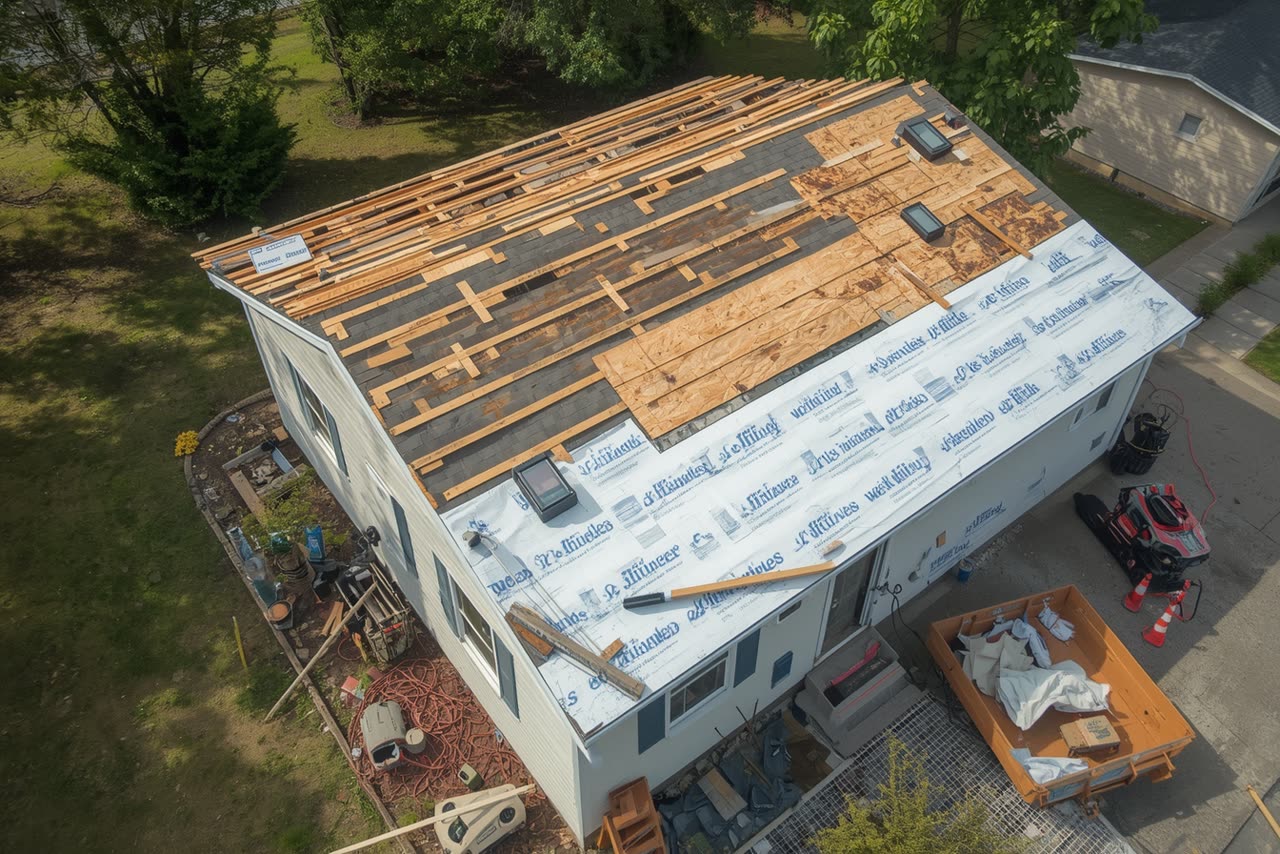
Tear-off. The crew strips the old roofing and underlayment, and inspects the deck. Soft or damaged boards are flagged, and you should be told about each one before it is replaced and billed.
Dry-in. Underlayment, drip edge and flashing go on. A roof is vulnerable between tear-off and dry-in, so a good crew watches the forecast and covers any open area at day's end.
Shingles and finish. Shingles are installed and ridge caps are set. Vents, boots and flashing details are finished.
Cleanup and walk-through. A magnetic sweep for nails, removal of debris and a look at the result with you. Ask for photos of any concealed work, such as decking repairs and flashing, before it was covered.
What a replacement contract should say
Do not rely on a quote on a business card. A real contract names the parties, the address and the full work description. It should include:
- Tear-off or recover, and the number of layers being removed.
- Product names and colors for shingles, underlayment, flashing, vents and ridge caps.
- Deck repair terms: price per sheet or per linear foot, and the process for approving extra work.
- Permit responsibility and who pays for it.
- Total price, payment schedule and the amount of any deposit.
- Start and finish dates as the roofer states them, and what happens if weather delays work.
- Cleanup and property protection, including landscaping and gutters.
- Warranty terms in writing, covering both materials from the manufacturer and the roofer's own workmanship, with durations and what voids them.
- A lien waiver at final payment, showing suppliers and subcontractors are paid.
Tennessee's consumer guidance notes that the home improvement law caps a required deposit at one third of the price. It also advises paying material suppliers directly if the contractor says money is needed for materials, getting three references, and never paying in cash.
Licenses, insurance and permits
Several rules hit roofing jobs, and they depend on both price and location.
- State license. A Tennessee contractor's license is required before bidding or price negotiation when total project cost is $25,000 or more. The roofing classification is BC-21, which covers roofing over $25,000, including gutters and vinyl siding. Check any license at verify.tn.gov.
- Home Improvement license. In Knox County, where the law has been adopted, a Home Improvement license is required for jobs from $3,000 up to $24,999. Blount, Loudon, Sevier, Anderson and Union counties are not on the state's list of counties that have adopted it.
- Insurance. Ask for a certificate of liability and workers' compensation coverage, issued directly from the insurer or agent to you.
- Permits. The City of Knoxville's Plans Review and Inspections office applies the 2018 International Residential Code, whose permit rule requires a permit before altering or repairing a building, and its exemption list does not mention roofing. The city does not say "reroof permit" in plain words on the page this site reviewed, so confirm directly. Knox County Codes Administration, the Town of Farragut and other offices each have their own process. Confirm with the building office, and ask the roofer who pulls the permit.
- Large or tall buildings. The City of Knoxville says a registered architect or engineer is required for a reroof on buildings of 5,000 square feet or more, or over two stories. That mostly affects commercial and multifamily work.
Read more in the guide on roofing permits and licenses in Knoxville.
Historic overlays and neighborhood rules
Some Knoxville neighborhoods sit inside historic overlays, where roof changes may need a Certificate of Appropriateness from the city's Historic Zoning Commission. Planning documents show staff-level approval for routine like-for-like asphalt shingle replacement in places such as Old North Knoxville and Fourth and Gill, while ribbed metal has not been approved in those two. Rules differ by district, and some areas are conservation overlays with their own standards. If your house is in or near one of these areas, call the Knoxville-Knox County Planning office before you choose a material.
What Knoxville conditions mean for a new roof
The Knoxville area gets about 52 inches of rain a year, based on NOAA's 1991 to 2020 normals at McGhee Tyson Airport. That makes flashing, underlayment and drainage the details worth paying for. The National Weather Service in Morristown records damaging wind as the dominant severe weather from June on, and the August 7, 2023 EF-2 tornado near Karns and straight-line winds of 60 to 90 miles per hour elsewhere in Knox County showed what a bad day looks like.
For wind, ask about the shingle's wind rating, the nailing pattern the crew will use, and whether starter strips and ridge caps are rated to match. For hail, local events have mostly been quarter to golf ball size, and some homeowners choose impact-resistant shingles, which may also earn an insurance discount. Ask your insurer before you buy.
Housing age affects what a crew finds. Census figures put the median year built at 1974 in the city of Knoxville, 1965 in Oak Ridge, and 1992 in Farragut. Older homes more often have multiple layers, thinner decking and skipped sheathing, which can turn up extra work at tear-off. Read the local pages for Knoxville, Maryville and Oak Ridge for more on each area.
What replacement costs, and what it returns
A fair price depends on roof size, pitch, complexity, material and decking repairs. This site cannot give you a quote. For published context, the 2025 Remodeling Cost vs Value report lists an asphalt shingle replacement job in the East South Central region (which includes Tennessee) at $25,939, with about 81 percent of that recouped at resale. The same report lists a metal replacement at $41,256 with about 57.6 percent recouped. Those are the report's standard job specifications, which are large and high-end, so a typical Knoxville job may cost less. Treat them as published averages, not quotes.
The roof replacement cost guide goes deeper on what drives price up and down.