
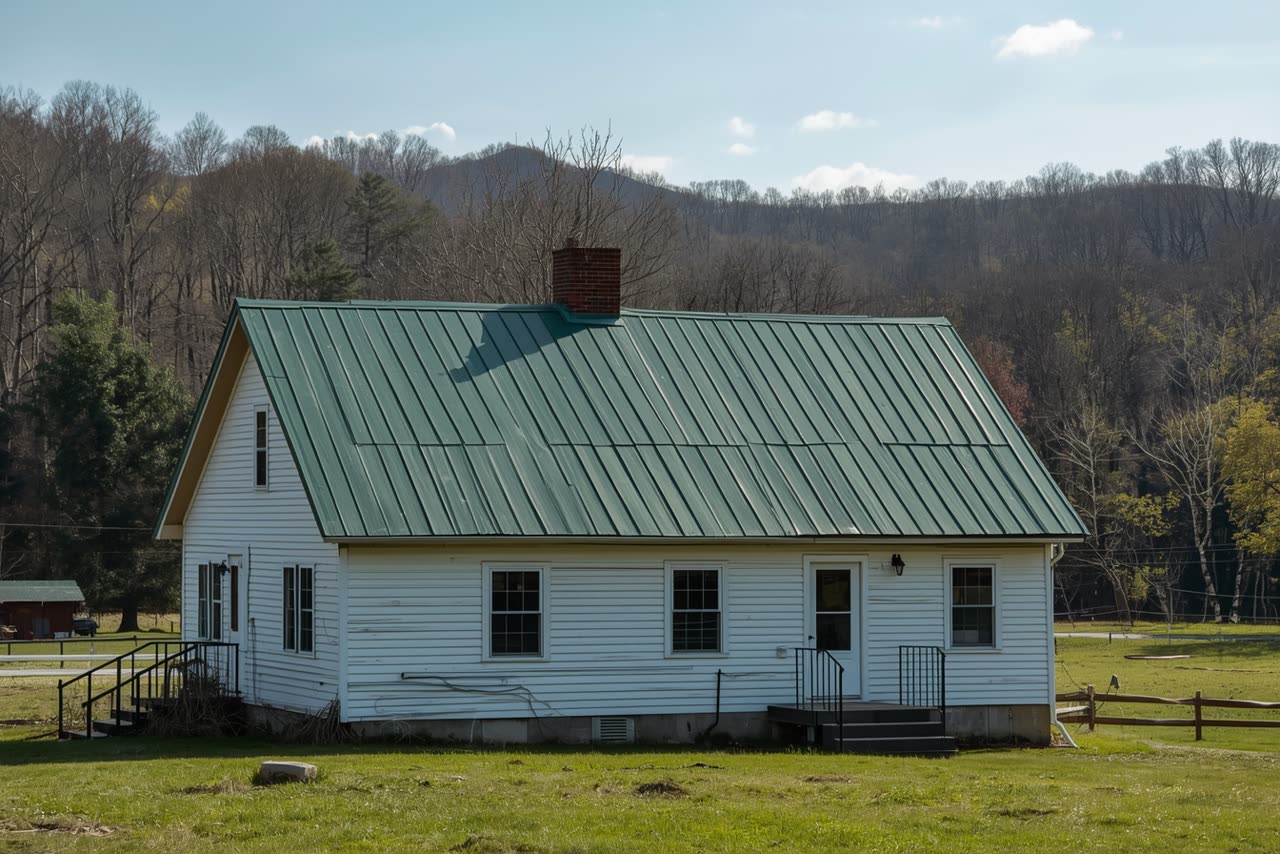
Sequoyah Roofing connects Knoxville-area homeowners with an independent local roofing company for metal roofing. This site does not install roofs. It explains what metal roofing means in practice around Knoxville and East Tennessee, from a house on a quiet street to a barn on a farm road, so that you can sort the real differences from the marketing.
"Metal roof" covers a wide range. At one end is a heavy-gauge standing seam system with hidden clips, designed to be installed once. At the other is a lighter corrugated or ribbed panel screwed through the surface, a common sight on barns and sheds. Prices, lifespans and maintenance needs are not the same, so start by knowing which one is in the bid.
Two families of metal roofing
Standing seam. Long panels run from ridge to eave with raised seams where the panels lock together. Fasteners are hidden under the panels or inside the seams, held by clips that let the metal expand and contract. Because no screw heads sit exposed to the weather, there are fewer places for water to enter. It is the more expensive and more precise system, and it is what roofers mean when they talk about a premium metal roof.
Exposed fastener. Ribbed or corrugated panels, screwed down through the face with rubber-washered screws. They go up faster and cost less, which is why they dominate on agricultural and utility buildings. The tradeoff is that screws sit in the weather. The rubber washers age, the screws can back out as the metal flexes with temperature, and the system needs periodic checking and fastener replacement.
A third group is metal that imitates other roofing: panels stamped to look like shingles, slate or tile. These can suit homeowners who want the longevity of metal with a traditional look.
Ask any roofer to say in the scope which family they are bidding, the panel gauge, the finish, and how the panels are fastened.
Materials and finishes
Steel is the most common choice, coated with zinc or an aluminum-zinc layer and then a painted finish. Aluminum resists corrosion and is used near coasts. Copper and zinc are premium, costly options with a distinctive look. For most East Tennessee homes, coated steel is the practical option.
What to compare between bids:
- Gauge. The thickness of the steel. A lower gauge number means thicker metal, so 24 gauge is thicker than 29 gauge. Heavier gauge resists denting and handles foot traffic better.
- Coating. The metallic layer that fights rust. Ask what the product is and how deep the scratch protection is.
- Paint system. Premium paint finishes resist fading and chalking better than basic polyester coatings. Ask for the paint manufacturer's terms in writing.
- Panel profile and seam height. Taller seams shed water in heavy rain more reliably.
- Underlayment. Metal needs a high-temperature underlayment under it, since the roof can get hot. Cheap felt can fail.
- Trim and flashing. Ridge, eave, rake, valley and wall trim. The details at the edges are where metal roofs most often fail.
Cost, and what the published numbers say
A metal roof is not cheap, and this site cannot quote a price. For published context, the 2025 Remodeling Cost vs Value report, which breaks results out by region, lists the East South Central region, which includes Tennessee, at $41,256 for its standard metal roof replacement job, with about $23,762 recouped at resale, or around 57.6 percent. The same report lists an asphalt shingle replacement in that region at $25,939, with $21,012 recouped, or about 81 percent. Nationally the report shows metal at $51,865 and about 50.1 percent recouped.
Two cautions. First, those figures come from the report's standard job spec, which is a large, high-end project, so an average Knoxville roof may cost less. Second, resale value is only one way to count the return. A roof expected to last much longer than shingles, with lower maintenance, may pay back in other ways if you plan to stay in the house. Whether that is true for your house depends on the product, the installation and how long you will live there.
The roof replacement cost guide explains the broader picture of pricing.
Common worries, honestly answered
Is it loud in the rain? On a solid deck with underlayment and attic insulation, metal is generally not much louder inside than other roofing. On an open-framed barn with no decking, rain on metal will be loud, because there is nothing between the panels and the space below.
Does it attract lightning? Metal roofing does not make a lightning strike more likely. If a strike happens, metal is not combustible, and it spreads the current. Grounding questions belong with an electrician.
Will hail dent it? It can. Thicker gauge steel resists denting better, and local hail has mostly been quarter to golf ball size in the events this site could verify. Some insurers treat cosmetic dents differently, so check policy language on cosmetic damage before you buy.
Is it slippery or dangerous in winter? Snow slides off metal readily, which can be a problem over doorways and walkways. Snow guards can hold it in place. Snowfall in Knoxville averages only about 4.6 inches a year, so this matters less here than in the mountains.
Does it make a house hotter? Reflective finishes can reduce heat gain. Ventilation and insulation matter more than panel color.
Can it go over shingles? Sometimes, with battens or underlayment, depending on local code and roof condition. The model building code says roofs with two or more existing layers must be torn off first, and tear-off is required when the deck is water-soaked or deteriorated. Confirm with the local building office.
Metal for homes, barns and outbuildings in East Tennessee
Outside town, metal is a familiar sight, and for good reasons. Exposed fastener panels are economical, shed water and leaves quickly, and go up quickly on simple shapes. The details change by building.
Houses. Look for standing seam or a heavier, higher-quality panel with concealed fasteners. A house roof has more valleys, dormers, chimneys and skylights, and each needs custom flashing. A premium panel installed with poor flashing will still leak.
Barns and agricultural buildings. Exposed fastener panels are standard. Check that the building's framing, purlin spacing and panel gauge match, because thin panels over wide spacing can dent and flex. Plan to re-tighten or replace fasteners periodically. Condensation can drip off the underside of metal in cold weather, and a condensation-control underlayment or vented ridge helps.
Garages, sheds and workshops. A detached garage or workshop is a sensible place to start with metal, as it is a smaller project and easier to compare against your shingle roof.
Porches and additions. A low-slope porch or addition may need a different system, as many panels require a minimum slope. Ask the roofer about the roof pitch for any product in the bid.
Ask roofers which metal systems they install most often on homes like yours, and why.
Neighborhood and historic limits
Some Knoxville neighborhoods have design reviews. In historic overlays reviewed by the Historic Zoning Commission, planning records show that ribbed metal had no record of approval in Old North Knoxville or Fourth and Gill, while standing-seam-look metal has been approved. Rules vary by district, and what is allowed in conservation overlays has not been verified here. If your house sits in an overlay, call the city's planning office before you order panels. Homeowners associations may also set their own limits, so read your covenants.
What to ask a roofer about metal
- Which system is this: standing seam or exposed fastener, and what gauge and finish?
- How are the panels fastened, and what is the plan for fastener maintenance?
- Who makes the panels, and what does the manufacturer's warranty cover, in writing? What does the roofer's own workmanship warranty cover, and for how long?
- Has the roofer installed this specific system before, and can they show local jobs?
- What underlayment goes under the metal?
- How will you handle chimneys, walls, valleys and penetrations?
- Who pulls the permit, and what is the permit status?
- What is the payment schedule, and what deposit is required?
Tennessee's rules apply to metal as to any roof. A state contractor's license (classification BC-21 for roofing) is required before bidding when the total project is $25,000 or more, and in Knox County a Home Improvement license applies to jobs from $3,000 up to $24,999. Ask for a license number and check it at verify.tn.gov, request proof of insurance, and keep any deposit to one third or less. The roofing permits and licenses guide has the details.
Weather and housing in the Knoxville area
NOAA's 1991 to 2020 normals put average annual rainfall at McGhee Tyson Airport near 52 inches, so water-shedding performance is the main test. Wind is the leading severe-weather risk from June on, according to the National Weather Service in Morristown. Metal panels, correctly clipped or fastened, can handle wind well, but the edges, ridge and trim are the vulnerable parts, and a poor installation lets wind get under them.
Housing age plays a role. The median year built is 1974 in Knoxville, 1985 in Maryville, 1992 in Farragut and 1980 in Alcoa, so many homes have older framing and decking to check before metal goes on. Metal weighs less than slate or tile, but the deck still has to be sound.
For local detail, see Maryville, Farragut and Seymour. If a shingle roof is leaking now, read roof repair first, and for the full replacement process, see roof replacement.
Maintenance and what to expect over time
Metal is low maintenance, not no maintenance. Plan on a walk-around each spring and after major storms. Look for loose or missing fasteners on exposed fastener panels, scratches that have exposed bare steel, sealant that has dried at trim and penetrations, and debris packed into valleys. Rinse off leaves and pine needles, which hold moisture against the finish. Avoid walking on panels where you can, since boots can dent thin metal and slip on a wet finish.
Repairs are possible. Individual panels can be replaced, fasteners swapped and flashing resealed, though a perfect color match on an older finish may be difficult. Ask the roofer whether replacement panels will be stocked and for how long the manufacturer keeps a profile in production.